

- 0755-83338558
-
-

QQ:2330667946Wechat
-
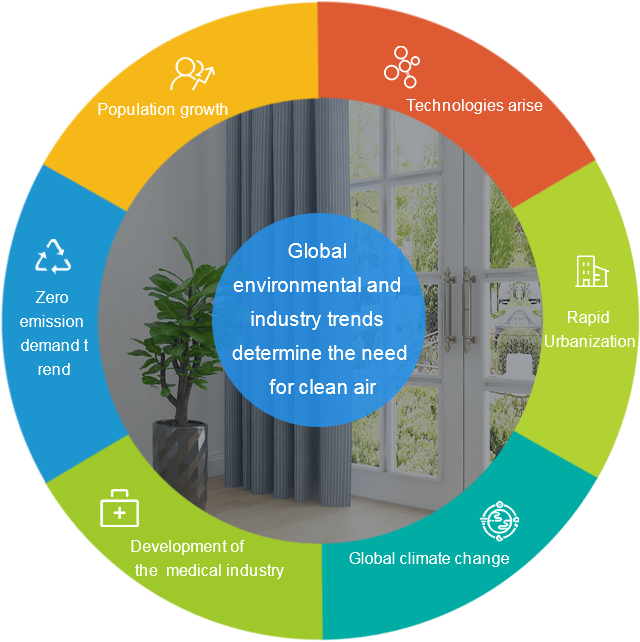

- More energy needs/manufacturing/construction/transportation lead to more pollution
- Air filters are widely used in all kinds of devices and factories
- filtration and separation technologies suitable for recycling needs
- Contaminants of allergenic and toxic substances appear
- Health care require more and better clean air, medicines and a variety of consumables
- More energy mining and utilization such as fire and high energy consumption
BreSafe nanocomposite filter material
The large-scale make use of the principle of electrospinning to produce uniform and low-weight nanofiber deep mesh materials is one of the technical problems of global materials science.4C Air adopts the principle of electrostatic spinning and applies patented technology to realize the raw material configuration, process equipment and manufacturing method of the large-scale production of nanofiber deep mesh material and nanometer filter material. At this point, BreSafe nano filter material came into being. The BreSafe nano-scale fiber made of polymer materials is actually a disorderly arranged layer, the fiber diameter does not exceed 500 nanometers, and the product weight can be controlled below 5g/m2. Compared with traditional micron filter media and microporous membrane filter media, due to its unique nanofiber deep structure, its MPPS particle size is much larger than other traditional filter media, and has a better filtering effect on nano dust below 0.1 microns
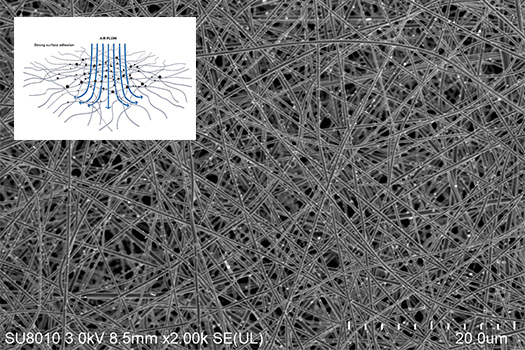
Features
The development of air filter materials
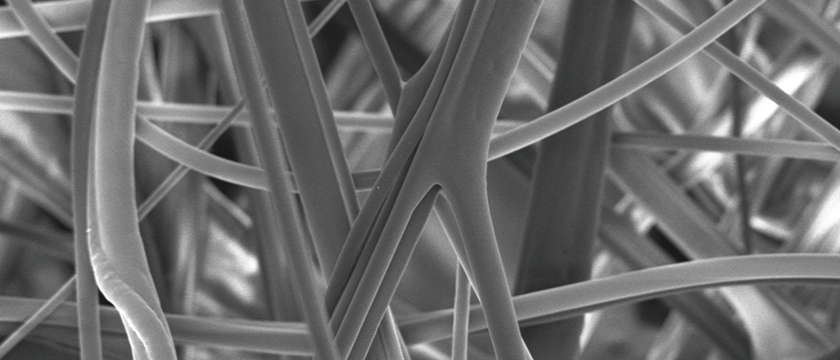
Micron fiber material filtration
Photos of traditional filter materials below 20um, the size distribution is irregular without uniformity
Disadvantages: 1. Easily to damage, not resistant acid-base 2. High energy consumption, high waste cost3High chemical volatilization, secondary pollution
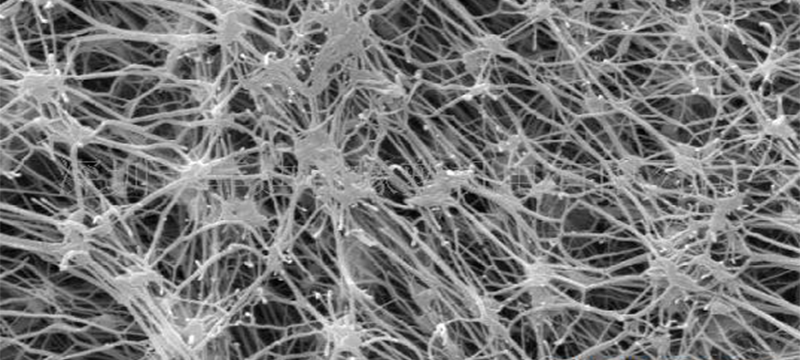
Microporous membrane filter material(ePTFE)
Disadvantages: 1. Low dust holding capacity 2. Cannot used in normal airy pollution environment

4C AIR BreSafe -nano filter material
Photo of BreSafe nanofiber material adsorbing particles below 20μm